

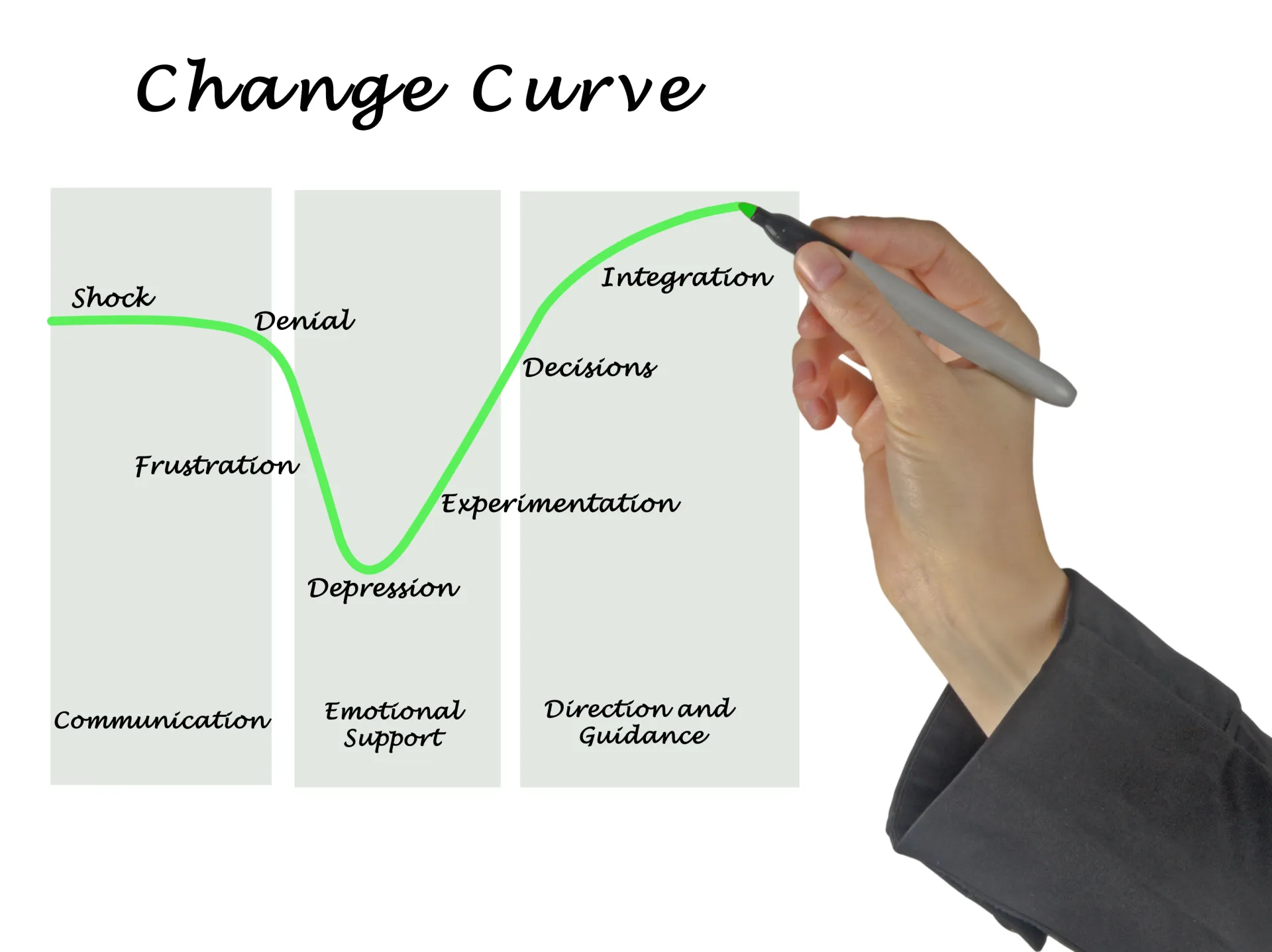
Change fails at the human layer. So that’s where we work.
The new system was sound. The reorganization made sense. The acquisition penciled. What broke was adoption — the fear, friction, and quiet resistance no project plan accounts for. Managing that layer is a clinical skill, and it's ours.
People don’t resist change. They resist loss.
Competence loss, status loss, the loss of knowing how Tuesday works — every significant change threatens something real to the people inside it. Ignore that and you get the classic failure: technically complete, behaviorally rejected, quietly rolled back within a year.
Our principal spent fifteen years managing human responses to disruption clinically before applying it commercially — including leading organizational turnarounds inside Walmart and the federal government. The method is the same: name the losses honestly, give people agency where it's real, equip the supervisors who carry the message, and pace the change to what the operation can metabolize.
What changes
The change adopted and still standing a year later; key people retained through the transition; productivity dip shallower and shorter than feared.
How we track it
Adoption by team and role, regretted departures during transition, time-to-baseline productivity, pulse-survey trust scores.
Where it shows up
The investment you already made — system, structure, acquisition — actually paying back, instead of joining the graveyard of rolled-back initiatives.
The human-layer playbook
Diagnose
Who loses what, where the informal power sits, which supervisors carry credibility. The org chart never tells you; the diagnostic does.
Narrate
One honest story — what's changing, why, what stays, what's genuinely uncertain — told by leaders we've prepared, repeated past the point of boredom.
Equip
Front-line supervisors trained for the conversations that decide everything: the worried veteran, the flight-risk star, the loud skeptic.
Pace & anchor
Sequenced rollout with early wins made visible, feedback loops that actually change the plan, and new habits anchored before the spotlight moves on.
Every engagement runs the same way: conceptual agreement on objectives, measures, and value — then one proposal, three options, one fixed fee.
See how we engageAn illustrative engagement
Composite scenarios drawn from the kinds of situations we work on. Details altered; client identities not used.
- Objective
- Transfer leadership from founder to successor without losing the senior team or the customers attached to the founder.
- Measures
- Regretted departures, customer retention through transition, decision authority actually transferred by function, founder hours per week.
- Value
- The handoff the bank and the family both feared became a non-event — the team stayed, the customers stayed, and the founder finally retired on schedule.
Illustrative composites for explanation of method — not statements of past performance, and not a guarantee of results.
Grounded in peer-reviewed research
-
Change succeeds through readiness — cognitive and emotional — at individual and group levels; ignoring the human layer predicts failure.
Rafferty, Jimmieson & Armenakis (2013) — “Change Readiness: A Multilevel Review,” Journal of Management, 39(1). doi.org/10.1177/0149206312457417
-
Teams where people can speak up about problems learn faster and perform better — the foundational study of psychological safety at work.
Edmondson (1999) — “Psychological Safety and Learning Behavior in Work Teams,” Administrative Science Quarterly, 44(2). doi.org/10.2307/2666999
Research informs our methods. Findings describe study populations — not a promise of results for any engagement.

Stephen Velasquez
Founder-owner of ZipHealthy for ten years — profitable, with no outside capital — and a former technology-product executive at Amazon, Microsoft, Walmart, and the U.S. Department of the Treasury. The advice you get has been paid for with the advisor's own payroll, and stress-tested at Fortune 1 scale. Every engagement is led personally, start to finish.
Asked by owners, answered directly
Before the announcement — ideally while the decision is still being shaped. Half the failures we're called to repair began with how people first heard the news. Early is cheap; repair is not.
Communication is one instrument. The work is behavioral: loss analysis, supervisor capability, pacing, and anchoring. A beautiful memo changes nothing by itself.
Yes. Stalled adoptions can usually be restarted: acknowledge what went wrong out loud, fix the two or three legitimate grievances fast, and rebuild from the supervisors outward. Pretending it's fine is the only unrecoverable strategy.
Make the change stick.
One conversation with the principal — no pitch deck, no junior associate, no obligation. If we can help, we'll show you exactly how we'd measure it. If we can't, we'll say so.
Prefer the phone? (479) 259-1390 · 240 S Main St, Suite #270, Bentonville, AR 72712
Most of our clients come to us by referral from other Northwest Arkansas owners. If someone sent you here — tell us who, so we can thank them.